
Building a Business for Good: What Milton Hershey Taught a Ghanaian CEO
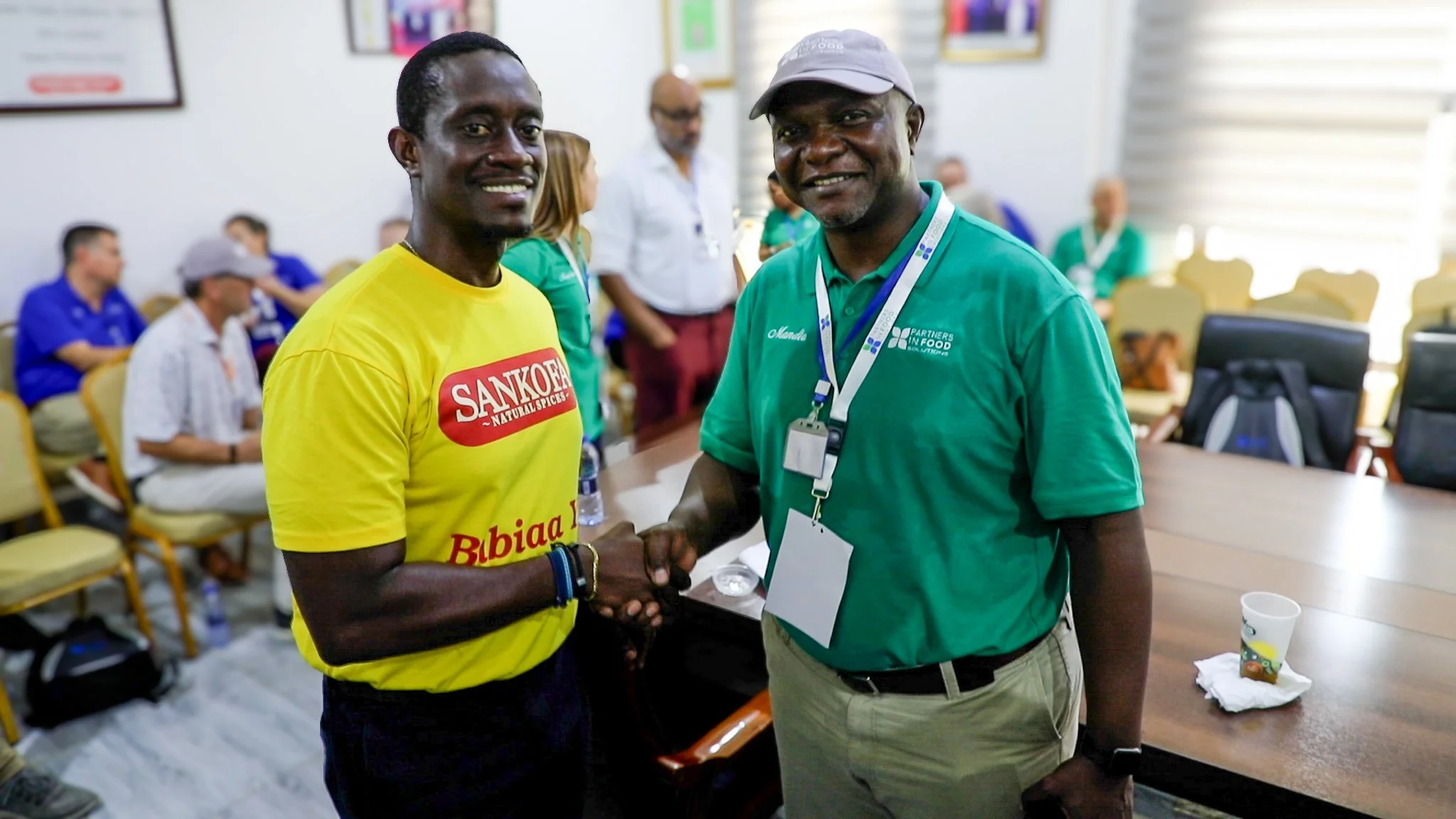
Nana Owusu Odum (left) and Mandla Nkomo (right).
Mandla Nkomo: Welcome to Deeply Rooted: The Business of Food in Africa. This is a podcast that explores how food companies across the continent are building businesses that are profitable, resilient, and bringing safe, nutritious, and affordable food to consumers in their communities.
Today’s episode takes us to Ghana, where food manufacturing isn’t just about what’s on the shelf. It’s about people. It’s about opportunity. It’s about long-term impact.
Our guest is none other than Nana Owusu Odum, the CEO of Gold Coast Foods. This is a Ghanaian company producing spices and other essential food products that are a part of everyday life for thousands of families. Under Nana’s leadership, Gold Coast Foods has grown with a clear belief that business can—and should—be a force for good.
Nana draws inspiration from an unexpected place: Milton Hershey, the founder of The Hershey Company, who believed that taking care of employees was central to building a successful business.
In this conversation, Nana shares how the philosophy resonates in a Ghanaian context, and how it shapes the way Gold Coast Foods invests in its people, its products, and ultimately its future.
This is a conversation about leadership. It’s about values—and what it really means to be deeply rooted in community, in purpose, and in the business of food in Africa.
Nana, thank you so much for accepting our invitation.
Nana Owusu Odum: Thank you very much. It’s a pleasure.
Mandla: So I’ve visited your factory a couple of times, and I really want people to build a mental picture of what you and your team have built back in Ghana. So let’s start right at the beginning.
I know there’s a really interesting story about why you even got interested in food in the first place. What drew you into the food business in Ghana?
Nana: First of all, what drew me into entrepreneurship—let me put it that way—is the vision that I had to build an integrated food city or an integrated food village.
That started when I was reading a magazine, and incidentally I chanced upon Hershey’s quotes. It struck me that the best advice is to get a vision. And he stated that he had a vision of a town where everyone had a chance. And so he was not just building a company, but he was building a town.
And I felt, wow—that is deep. That is really striking.
And so from that day, it just dawned on me and stayed with me: the need for us to try and do something similar in Ghana, or in Africa.
That was when the entrepreneurial dream was birthed—just by reading that line.
So then I started reading more about Hershey. I bought a couple of books and tried to understand a bit more as to what he did and how he got to where he was. And that was where the inspiration started from.
From there, I registered a company—actually just on the basis of that—without any products. So I did not know what I wanted to produce. Neither did I know what I wanted to sell. But I registered a company on the belief that I had to get a vision, and I had to build a town where everybody had a chance.
But then it had to be based and driven by industry so that it is sustainable.
And I started looking around as to what we could start the company with.
We started with moringa, and then we ventured into spices. It’s evolved every day, and here we are today.
Mandla: You know, Nana, every time I hear that story, I hear an aspect of it that I missed.
Help me understand why you even thought it was possible for something like what Milton Hershey described—or built—in the United States.
Why did you think it was even possible for this to happen in Ghana? It’s one thing to have the vision, but all of us can dream dreams and have visions. What was that moment that allowed you to say, “You know what—if Milton Hershey could do it, we can do it here in Ghana, because Ghana needs it”?
Nana: Well, I think when I read that quote, I went a bit deeper into the story of Hershey, and I tried to research a bit more about him.
His story was very familiar to mine at the time he started. He didn’t start with anything. He started with nothing. He went through a number of failures, actually, and with family challenges, and support here and there. He failed—but the family didn’t. The family kept supporting. And at a point, no one was supporting, but he went through the difficulties.
So I could relate.
Okay, he was in the United States, but he had peculiar challenges that were no different from the typical challenges of an entrepreneur.
And so I felt that if he could do it—in spite of all the challenges that he had and everything that he went through—then of course it was possible.
I must admit that I did not fully believe that I could do it. But just because of that statement—have a vision—it was this vision and his story that kept me grounded.
Like, if he could do it, then it is possible.
Our challenges here were a bit different. But failure, in my view, is failure. And he went through a number of them.
Starting a candy shop in Philadelphia, failing after six years. He tried again in Chicago and failed. He tried again in New York—it failed again. And most people, including financiers, had written him off. He went to the family farm in Pennsylvania penniless, but with just one key insight: caramels.
So for me, the story was quite intriguing. If he could fail and still achieve what he wanted to achieve, then the most important thing was the vision.
Once I bought into the vision to build something extraordinary, and to integrate industry with livelihoods, I felt I was on the right track—so I could face anything.
And I think for our listeners who might not know: Hershey is actually one of our corporate partners. This is a business that was established in 1894, so it’s been around for a while. Right now, it’s got over 90 brands, and a total workforce of over 21,000.
So a story that started as far back as 1894 has actually inspired what we are talking about today.
Mandla: And what Nana is taking us through today…
Nana, when you have a vision like this, is this a vision that you keep to yourself? Is this a vision that you share with other people? Because it takes a lot of people to bring a vision of this nature into life.
Who are some of those people that helped you believe it was possible, directed you in places where you could get help and support, and ultimately delivered what is today Gold Coast Foods?
Nana: All right. So I think one person that stood out was my grandmother, who always encouraged me to go forward with it.
I was also fortunate that I had a couple of people that I shared the vision with, and they bought into it immediately. Luckily enough, they’re all with me even now—working together and aspiring to achieve that vision.
The other thing I did with regards to that vision was that I actually got somebody to sketch the vision for what we wanted to achieve. I shared it with those people that I started with.
We decided to take more or less the same steps as he did, because he didn’t build his factory in a big city. He built it in the middle of cornfields in Pennsylvania, where there was basically nobody. And he knew that workers wouldn’t move there.
So I said, okay—we are leaving Accra. We’re also going far away where nobody is. We are going to start just the same way that he did.
So you remember when you visited my factory? It was almost in the bush somewhere. There’s nobody.
And even when we decided to move, like I said, my grandmother was quite instrumental in believing that I should go ahead and do it.
There were some people I also discussed with—especially in the beginning when we were trying to raise some money—who felt I wasn’t thinking properly.
But in spite of it all, I could see the vision. I believed that if someone had done it, then it was possible. And there was nothing like that in our part of the world. So I felt, okay—let me attempt it.
Mandla: And yes—here we are.
Because we’re on a podcast, we have to describe things. So Nana, could you take people on a journey?
First of all: where is your factory located in Ghana? You say you moved out of Accra—where is the factory located?
What is the physical infrastructure that you’ve been able to build there? What are the products you are producing? What is the number of employees? And how are these employees actually housed?
Remember, you’ve told us you had this very vision—and now I know you’ve executed it.
Help our listeners really understand how remote your factory is, what you’ve done at this place, and what kind of products you have created together with your team.
Nana: Okay. So we are located in the Central Region in an area called Gomoa. It is about two and a half hours from the central district of Accra.
We’ve been able to build our own factory. Currently we have three different factories where we produce three different food products.
We have been able to build 21 SKUs under four different brands. We have two brands for spices, one brand for ready-to-eat and cereal, and one brand for teas and beverages.
We currently employ close to 300 people directly, and more than 100 people indirectly, including some farmers.
We house about 30 to 40 percent of our workers within our factory facility. So we provide accommodation to these people. We also provide free lunch to all the workers that work here. We provide them with healthcare, insurance, and everything that is intended to make life better and comfortable for them.
In terms of what we are doing presently: like I mentioned, we have 21 SKUs. We are currently selling our products in Ghana, in Nigeria, in the US, and also in the UK. And we are expanding aggressively into other African countries and trying to grow our presence and footprint.
We have put in place an ecosystem that ensures integration of the work we do and the living of our people—to improve their living standards and make life better for them.
We also introduced some educational and training activities to help improve the lot of the people that join the company.
We’ve been able to grow our brands by 400 percent, and grow our revenue by more than 2,000 percent over the last five years, with a gross margin around 40 percent and EBITDA in excess of 20 percent.
And we have all these people around the work, and they live here.
I personally believe it is counterproductive to have people travel for more than 10 or 15 minutes to get to work. Here they are able to get to work in five minutes, which makes them more productive, well-rested, and energized to do good work.
And we keep pushing.
Mandla: Yes, that is fascinating.
I’m just thinking as I’m listening to you: some of the CEOs of listed businesses in Nigeria, in Ghana—your native country—in Côte d’Ivoire, in Kenya, in Johannesburg, probably do not have some of these services and offerings that you are giving to your workers.
So it’s very clear that people are at the center of your business.
I’d like to understand a little bit more around something that maybe many people don’t know. I’ve seen your employees, and a lot of those employees are not elderly people. These are young people.
Can you take us through the story of how you came to the decision of choosing to have young employees, and then helping those young employees acquire skills that are able to produce products that are now finding their way to the United States, to the United Kingdom, and to other African countries?
Talk to me about how that came about.
Nana: Right. So what I realized was that we had a lot of young people coming out of secondary school and not being able to continue to tertiary for financial reasons.
In most cases, these people end up on the streets and they end up doing things they should not be doing. They don’t have focus, they don’t have direction, and they don’t have guidance. And there’s also no money for them to move on with their education.
For me, that was a major, major problem that we were dealing with.
But these are also people that are generally smart and determined to make something out of their lives.
So we made a decision that we would hire these people who do not have experience. And because they do not have experience, they have very limited opportunity in their workplace. We provide them with training, mentorship, guidance, and help shape them.
We coined a phrase to say that what we are here to do is to make life better for our customers and ourselves. And that is a shared vision. We own it, we live it, and remain committed to leading the way.
What we wanted to say was: we are going to make life better for our customers through the products we produce, but also for the people that work with us.
This vision must be shared by everybody in the company.
So we brought in these people. The average age here is about 28 years. Some of them are managers. Some are team leaders. Some are supervisors, senior supervisors. These are people that just came from school.
About 70 percent of the people that work here came straight from school and did not know anything.
But we created a culture and system based on learning. We help them understand what we are trying to do, build the right attitude, the right mental models, and integrate them into the vision and what we want to create.
They are doing amazing.
When I started with this drive, people were saying: “No, if you want to do social things, do social things. If you want to run a business, run a business—because business is about money. And if you use the resources you have to take care of people, the business will collapse.”
But one thing I’ve come to realize is: when we focus on the people, the people give the best they can give—and the results have been phenomenal.
Like I said, we’ve been able to grow revenue by over 2,000 percent over five years. Our margins are always about 40 percent, EBITDA above 20 percent. The company is healthy and cashflow positive.
So it’s a testament to the fact that integrating people with economics makes a lot of sense.
The results demonstrate the same.
It also confirms that when young people are given a chance, direction, and guidance—and are made to believe that what we are building is bigger than any of us—it becomes something we want to leave behind as a legacy.
We want to demonstrate to the rest of the world and the rest of Africa that this is possible. We should not just leave everything to government.
Industry can integrate the well-being of people with work and deliver optimal outcomes.
That has shaped my thinking even further. We have remained more committed to doing this than ever.
We are expanding our accommodation spaces to house more people. We are intensifying our support. We’ve introduced a lot of mentorship programs to develop the young ones coming in.
We’re trying to instill into them discipline, purpose, vision, commitment, and a sense of direction.
It seems to be moving in the right direction, in spite of the challenges we deal with every day.
If you take care of the people, the people will take care of the business.
There is a solution to the youth demographic in Africa: you need to give young people a chance.
Mandla: I can testify to the fact that I’ve seen this with my own eyes. I’ve even seen your team recite the values and mission of this business without even reading it.
So this is not just talk. This is something that’s happening.
Nana, everyone always talks about the importance of smallholder farmers, and why companies like yours are important to these farmers—essentially at the bottom of the pyramid.
Can you talk very briefly about how your business is helping smallholder farmers?
Nana: Yes, sir. So we buy from local farmers.
The value we add is basically to provide them with a ready market and provide them with support.
There are a lot of farmers around in Africa and Ghana. They are not able to produce on a large scale. Where they are is a bit remote, so they don’t have access to ready markets—which means we have a lot of post-harvest losses.
What we do is we have set up aggregation points where we collect from these farmers who do not have access to the market. We go directly to them. We collect whatever they’ve been able to produce so that at least it doesn’t go to waste.
We aggregate it and bring it to our factories to use.
We also provide them with support to ensure they are able to continue to produce. We provide them with tools, Wellington boots, and other things. We even give them advance payments in order for them to keep production going.
This is one way by which, if a lot of companies would join this crusade, we can support a lot of smallholder farmers.
Currently, we work with many of them in Ghana. Because of what we do, some of them still have hope and continue to keep farming.
Although they do not have mechanized farming systems, because whatever quantities they produce we are able to buy regardless, it encourages them to keep on and keep expanding organically—in a way that is more sustainable for their livelihoods.
Mandla: And I think that is really why it’s important for food companies like yours to continue to grow, because it means a lot to rural farmers.
It would be fair to say that a lot of the stuff you and your team are doing is groundbreaking on the African continent. You are not running away from the challenges featured in magazines and television programs about Africa and Africa’s food systems. You are in the solutioning space.
Now, I want you to turn your attention to the food industry in Africa as a whole.
What do you wish more people outside Africa understood about food manufacturing on the continent? What message do you have for people outside the continent, and what would you hope they would understand about the kind of work you are doing?
Nana: Okay. So first of all, I think most of the time the image that is put out there is not entirely appropriate.
We have peculiar challenges that we deal with every day, like everywhere else. But the food processing space is growing incrementally. It is making inroads and having a real impact on people and lives.
The major challenge within our space is most of the time technical know-how and funding. These are the two big things.
But in most cases, when you dig deeper, you realize that the bigger challenge is technical know-how. Because once we know and we understand how things should be, and we get the knowledge required, we are able to manage the resources we have to some extent.
Of course, as the business grows to a certain level, funding also becomes critical. But these are the two main things.
Urbanization keeps increasing. The desire for processed foods, packaged foods, value-added food keeps increasing.
The impact is not just on the business—it goes deep down into farmers, households, and families that would be struggling.
So what the food space is trying to do here is to add value to agricultural raw materials and to add value to the lives of the people that produce these things.
The population of Africa is increasing. We are importing significant amounts of food. But there is real opportunity here because we have the raw materials, we have the people, we have the willingness to get things done.
So most of the time, it’s technical know-how and some amount of funding that is the limitation.
We have worked with PFS for a while now, and they have been able to help us deal with the technical know-how side of things. That has been of tremendous importance, because I know very well that in the absence of that, there are a lot of things we would struggle to really know.
Having access to people who have done this over the years—having conversations and getting people to advise and make input into what we do—has really helped our team.
Like I mentioned, most of the people that work here have not worked before.
We have a very youthful population in Africa. So there’s a lot of inexperience, and that is mainly the challenge sometimes.
But in terms of raw materials, willingness, and commitment to get things done—it is very high.
Mandla: Yeah, I think that’s absolutely right.
And I’m sure listening out there is a young person like yourself. When they hear your story, they’ll be forgiven to think that it is very easy.
But even though you and your team have achieved a lot—phenomenal growth in the business, excellent margins—you still have constraints you’re navigating.
I remember you telling me about trying to establish yourself in a neighboring Nigeria. What are some of the biggest constraints that a growing business like yours is facing in trying to scale the model you’ve built in Ghana?
Nana: Yeah. Okay.
For instance, in an attempt to get to Nigeria, it took us about three years to get the right certifications to operate in that market.
Clearly, most of the countries are still very disconnected in terms of how goods and services move around. So that is most of the time a very big hurdle.
All things being equal, we should be able to move goods in and out of one country with ease. But it is not the case.
I know there is this African Continental Free Trade Agreement that we are trying to implement, but still there are limitations in trying to get products within Africa.
That is on the one side.
The other side is what I mentioned: technical know-how and skills that enable us to scale sensibly without damaging the foundations of the business.
The third thing is funding. Funding always remains a big challenge. Very limited sources of funds, and very high interest rates—especially when you are dealing with the bank.
So these three things are challenges we deal with on a daily basis. And these are some of the reasons why it’s quite difficult to scale and replicate the model we are building.
Mandla: Nana, you had the opportunity last year to visit Switzerland, to visit Spain…
Nana: Okay. It’s very funny that I started a food manufacturing company, ran it for about six or seven years, and had never visited a factory before. So it’s very ironic.
Everything was based on what I read, what we discussed, and a few common things.
So the opportunity to visit world-class factories like McCormick and General Mills—and even Cargill in Ghana and other places I had the opportunity to visit—was an eye-opener.
It was seriously a very big eye-opener because it was my first time in any factory at all, and I had the privilege of visiting world-class factories.
I learned a lot about the quality of the process flow, the design of the factories, the little details that we missed down here, and a lot more.
It was a real eye-opener.
When I came back, I had to get my team together and try to implement most of the things immediately.
And I can confirm that since the visit, we managed to improve a lot of things within our production process.
I also came back and shared with them some of the discovery in terms of behavior, mindset, organization, and the level of order within those factory spaces—which was missing at the time—and which we’ve been able to implement.
So yes, it was a great opportunity. And that little action really provided exponential outcomes in what we do here in Ghana.
Mandla: Another fascinating story, and absolutely inspiring.
I know that you’re a guy who thinks a lot about the present, but also about the future.
Let’s look forward 20 years from now. Could you describe for me what Gold Coast Foods is going to be looking like?
Nana: What we are trying to do is to integrate industry with living.
So in the next decade or two, we believe we are going to build the number one diversified food company in Africa, and have an integrated system where we have a number of factories producing healthier, affordable, and convenient food—not just supplied in Ghana, but supplied across Africa.
We believe that in the next 20 years, we’re going to have a system where we can replicate what we are building in Ghana in other African countries.
We want to build factories, accommodation, social and other living spaces, and do in other places what we are doing in Ghana.
Our objective is to be in more than 20 African countries, and to be physically present. When I say physically present, I mean replicate the same model in more than five African countries over the next decade or two.
We want to create employment for more than 5,000 Africans and provide them with not just jobs, but hope—and provide them with a place where they can call home and work at the same time.
Our ultimate objective is to be a social partner—to create the kind of environment where people can live and work in harmony and achieve their goals and objectives.
Where we can provide decent living for families, whilst we provide decent employment for them across the continent.
And most importantly: support farmers and people who grow the raw materials that we use, in a way that will make them better off than they always have been.
So in the next 20 years, Gold Coast Foods is going to be one of the biggest—if not the biggest—diversified and integrated food companies in Africa.
That is what we are working towards, and we believe we’ll be able to achieve it.
Mandla: And I can say to those listening now: for as long as I’ve known you, when you say something like that, I know you’ve given a lot of thought to it. You’ve learned in detail, and it’s going to happen.
I think a lot of the listeners of this podcast will be out there looking out for when Gold Coast Foods is going to come knocking on their door to supply the excellent products that you supply.
I want you to say a last parting word to young Africans.
We’ve seen it in Kenya with what we called the Gen Z protests. We’ve seen it in Tanzania. We’ve seen it across the African continent. Young people are agitating for a different set of circumstances.
You are a food entrepreneur. What words of encouragement or advice do you have for young Africans thinking about starting food businesses? What kind of mindset should they have—more than capital or equipment?
Nana: Okay. I think we need to look beyond the problems or the challenges that we have.
Young people must believe a bit more. They must have a vision that is bigger than them—daring.
But most importantly, they must start from somewhere. They shouldn’t wait for government, or an NGO, or something. They just have to start.
They have to start from somewhere.
The vision could be big. The dream could be big. The challenges will be there. But they have to start.
For me, that is the most important.
That was one of the things my grandmother told me. She said: all you need to do is start. And once you start, you keep going.
You see afar in your mind’s eye, but keep your head down. Because when you keep your head down, you solve the problems as they come. But in your mind’s eye, you know where you are going.
And I think that is very important.
Most of the time, people don’t believe it is possible because of the challenges around us, but it is indeed possible.
I started this business from my grandmother’s house. We were doing our milling and packaging under a staircase—a very small space. Then we moved to a dining hall. One step at a time, we kept moving.
And don’t keep the vision to yourself. Share it with your team. Make it a shared vision so that it is owned by more people than you.
Because when that happens—even when you feel like giving up—there’s somebody on your team who will call you and say, “Look, it’s a shared vision. Let’s keep moving.”
So don’t keep it to yourself. Share that vision. Get a group of like-minded individuals to join the journey.
But the most important thing is to start.
Mandla: So there you go, ladies and gentlemen.
Today’s conversation with Nana Owusu Odum is a reminder that the strongest food businesses are built on more than products. They’re built on people. They’re built on inspiration. They’re built on vision.
By drawing inspiration from Milton Hershey, Nana shows us how leadership rooted in the care of employees and community can drive lasting impact and build a successful business—even in a different, and maybe some might say difficult, context like Africa.
Thank you for listening to Deeply Rooted: The Business of Food in Africa.
Make sure you don’t miss an episode by subscribing at deeplyrooted.blog or on Apple Podcasts.
Until next time, stay deeply rooted.