
Where It All Began: The PFS Story
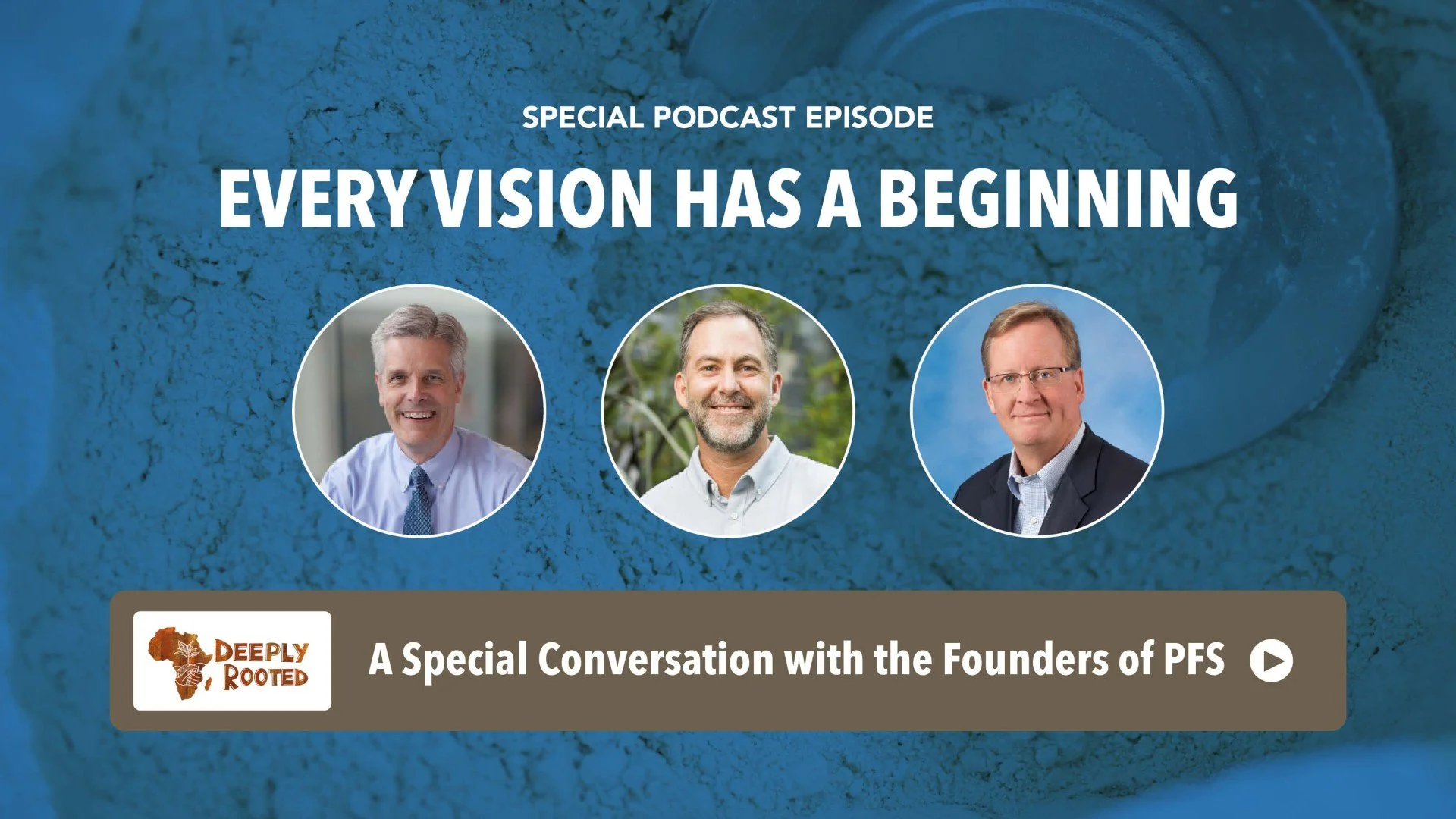
PFS Founders Peter Erickson, Jeff Dystra and John Mendesh
Every great journey begins with a vision. For PFS, that vision laid the foundation for a story of growth, purpose, and possibility.
In this special episode, Mandla sits down with PFS co-founders Jeff Dykstra, Peter Erickson, and John Mendesh to reflect on where it all began. Together, they revisit the early days of PFS, the inspiration behind its establishment, and the vision that brought it to life. Through their conversation, they share insights into the journey of building PFS and the ideas that have shaped the organisation over the years.
As PFS looks to the future, the conversation also explores what lies ahead, the opportunities for continued growth, and the importance of staying true to the vision that started it all.
Mandla: Welcome to Deeply Rooted, the podcast about the business of food in Africa, where we explore the ideas, the partnerships and innovations that are shaping the continent's food systems from the ground up. I'm your host, Mandla Nkomo. It's often said that every good idea has many fathers. And I think this is true about Partners in Food Solutions, where it turns out that chance conversations in Davos, a connection in Minnesota, and the story about a bar in Kenya all provided the backdrop for what has become Africa's largest platform, connecting hundreds of businesses at the forefront of solving Africa's food and nutrition challenges. With a global pool of talented volunteers that solve meaningful and significant and challenges that these businesses have in their operations. So at the end of 2025, Partners in Food Solutions had worked with over two and a half thousand African businesses. They had been able to connect them to over four and a half thousand global food processing experts and unlocking close to two hundred thousand hours of meaningful engagements. Well, today we've got three of the founders of this great idea, who'll take us on a journey of how this idea was born, how it was nurtured, and how it blossomed into what we know as PFS today. And I'm going to start by introducing Peter Ericsson. Peter, welcome to Deeply Rooted.
Peter Erickson: Thank you. Happy to be here.
Mandla: So, Peter Erickson, you know, for his sins, is the former executive vice president of for innovation, technology and quality at General Mills. Peter is now retired, so he's somewhere at the coast. Earning his retirement. But Peter joined General Mills, in 1998, where he led global teams to invent and commercialize food products, technologies that nourish consumers and build trusted brands through a focus on quality and food safety. He currently serves on several boards and is the co-founder and past board chair of Partners in Food Solutions. Peter has He told me that he's the third or is it the fourth generation Peter. Food scientist in the Erickson family. He remains active in the academic community as a food science advisory board member. So join us as we explore his journey from industry leadership to global impact. So Peter, you are welcome. And are we looking forward to talking to you more. But Peter's partner in crime is none other than, John Mendesh, also known as Mendy. So welcome to Deeply Rooted Mendy.
John Mendesh: Thank you sir. It's great to be here.
Mandla: So John is a is a chemical engineer. And I think if I'm to be fair, that doesn't quite do justice to the skills and abilities that this gentleman has. John is a chemical engineer who also has an MBA and has spent over thirty three years working in the food industry at General Mills, he rose to the position of Vice President of Research and Development. And John has worked at every facet of food production, from developing global cereal products to managing international operations at Yoplait and overseeing key corporate partnerships. John will be taking us through his own journey from food industry leader to passionate advocate for global food solutions. And then last but definitely not least, is the guy that, was brave enough or some might say crazy enough to listen to these first two gentlemen and actually commit half of his life to PFS. We're joined by the founding CEO of Partners in Food Solutions, my good friend Jeff Dykstra. Welcome to Deeply Rooted, Jeff.
Jeff Dykstra: Thanks, Mandla. Great to be here.
Mandla: So, Jeff is one of the three co-founders of Partners in Food Solutions and its longest serving CEO. I've only been around for two years. Jeff has more to, to, to do with who PFS has become than I have. But, since helping launch PFS with General Mills in 2008, Jeff has built a pioneering platform that connected the expertise of leading global food companies with more than two and a half thousand. African food businesses across eleven countries. Jeff is an Ashoka Fellow, a Bush Fellow and an Oxford trained organizational leader and an accredited leadership coach. With decades of experience spanning Cargill, World Vision, entrepreneurship, and international development. Jeff has a real deep insight into African food systems, cross-sector partnerships, social enterprise, and purpose driven leadership. So we are happy to have Jeff on board. So, gentlemen, many of our listeners have been inquiring, have been asking, have been pestering me about how does RFS even start? How does it grow to, to become this platform that I christened the largest platform on the continent, doing the kind of work that we do to create a superhighway of knowledge and expertise from the global north to Africa's fast growing sector. So I'll start with you, Peter. Take us back to the challenge that was issued by Kofi Annan and the response inside the corridors of General Mills. And how did a broad concern about hunger and nutrition become the decision that the company made to share its knowledge and people. Take us there, Peter.
Peter Erickson: So, you know, I’ll go back to this, this, this amazing chance encounter that that our CEO, Ken Powell, had with Kofi Annan at the Davos World Economic Forum, where Kofi asked a simple but incredibly important question, which was, how can the six biggest food company in the world make a meaningful difference in eradicating food insecurity around the globe? And Ken is an amazing individual, an amazing leader, a humble man. He took the challenge on, brought it back to General Mills and asked his leadership team the same question. And, asked us to come up with ideas on what we thought could be done by General Mills to help make a difference in addressing the issues of food insecurity. At the time I had the opportunity to, to lead the, the research and development and innovation organization. And I always said that our job was to experiment. And if we as an organization weren't experimenting, who else in the company would be experimenting? And so we tried a bunch of different experiments, including one experiment where we packed one million relief meals for Africa in what we thought would take three years. We did it in three months. And what we learned from that experience was if we made it easy for our employees to give of themselves, they would absolutely come and they would give all that they had. It also taught us that we could do more than just packing relief meals. We could leverage all of the knowledge and experience of this amazing team of engineers, scientists, technicians to be able to share their knowledge to help make a difference. Addressing food insecurity. And with that simple insight, we began to experiment again, but this time experimenting on the continent of Africa.
Mandla: Amazing. Amazing. And I know that, you know, good innovators and, uh, people loving to experiment. John. That meant that, uh, you guys actually needed to get on an airplane, uh, you know, travel to the continent. And, and I want you to take me to the early days of journeying through eastern southern Africa. What did you see? You know, that convinced you that food processing was the critical place for PFS to intervene? And here's why. Everybody wants to support primary agriculture. The farmers. Why did you guys look at food processing? What did you see?
John Mendesh: Yeah. I mean, it's a great question and a couple of things. And seeing is believing. And as our R&D folks, we felt like we had to go there. And it was the three of us, Jeff, Peter and I. And as we kind of literally stumbled around, a variety of countries in Africa and just kind of got our head around the food industry. I'll never forget a story that Jeff actually started, uh, about the mango season in Zambia, where there was a time of year where mangoes are completely plentiful, right? And they're dropping out of the trees, but a whole bunch of them go to waste. Yeah. Um, and to your point around, uh, we saw a lot of help on growing more. But we didn't see a lot of help on, uh, actually helping the farmer, process and bring their crops to market. Um, so, and it turns out that that's what the likes of General Mills and these big food companies do right there. They sit in the middle of the value chain. I forget what the number is. Somebody maybe quoted this long ago, but 35% of the food grown in Africa doesn't make it to the consumer.
Mandla: Yep.
John Mendesh: 35% of the food in the developed world, more developed world, it gets wasted post-consumer. So just think about that. There's 70% of the food that's not finding its way to somebody's stomach. And we just felt like we had a unique spot to play in the middle of the value chain. And as we wandered around, again, we could see where we went had a whole lot of value. One of our key tenants was, is there an unmet need and are we uniquely qualified to fill it? And it felt like we were. Uh, because it's right where we play in the middle of the value chain, which we felt like we could make a significant impact in, in adding value there.
Mandla: 100%. And I think I like this concept, John, of, you know, uh, is there an unmet need and are we eminently qualified to meet it? But we also know, Jeff, that, ultimately it's about entrepreneurs. Entrepreneurs are the guys that, that get things done. And I want you to, to take us to what were the African entrepreneurs telling you at that time? And, and how did you perceive your, your perspective differ from the assumptions that many other international organizations are making where they are putting a lot of their effort into, into primary agriculture. But you clearly were talking to entrepreneurs. What were they? What were they telling you?
Jeff Dysktra: Yeah, I think, you know, going back to that those years, two thousand and eight, um, as you know, I had been living in Zambia, um, and started starting to sense, uh, the limitations of traditional aid, um, know that there was a place for it, know that it was needed. And I actually started meeting some entrepreneurs on the continent, um, that, that I sensed were, these are the people that are going to shape, um, shape their communities and shape their, their, their cities and their country, um, as builders and, and I think, um, as General Mills, you know, John and Peter stepped in forward into this, just saw this tremendous opportunity to, to leverage the know-how of 150 years with these nascent entrepreneurs, that if they could get what they needed, um, they, they, they knew the problem, they knew the markets, they knew the opportunities. And as John was speaking, I was just thinking back to a guiding quote early on, uh, Greg Page, the former CEO of one of our partners, Cargill, I think he was the first person who said, if not, I heard him say it many times that a farmer without a market is a gardener. And there are too many gardeners still across the continent, and that's what we were seeing. And we thought we have a unique opportunity to take many of these people who are maybe starting to grow more because of some of the investments in primary agriculture, but still didn't have that market. And so there was just this kind of magical hand in glove fit of at that time, at that moment, and understanding that business had a role to play in shaping some of these social challenges. At a time when, when African farmers were starting to grow more, to be able to step in and leverage that know how, that General Mills had in, in massive quantities, to specifically address that issue.
Mandla: And I think it feels to me that you, you are getting this validation, in the field that first of all, there was a need for post-harvest processing. There was a need for, uh, ensuring that there was a reduction of food waste and loss. Aand there were the entrepreneurs who seem to be willing and ready to respond to this challenge. But ultimately, you still need a model. And I don't drink a beer myself, but, I sit around people who drink beer and I hear there's a bar in Nairobi that, uh, kind of, uh, provided the beverage that helped you all to kind of figure out the model. And I'm going to start with John, uh, take us to, to this conversation at a bar in Nairobi. What was the original idea? Why? What made it feel different? And which parts of today's FS model, uh, were already visible at that time? When you set that bar and had a napkin and a piece of and a pen. Yeah.
John Mendesh: And by the way, I still have that napkin, but the way.
Mandla: So, you need to bring it back to PFS for our archives, John.
John Mendesh: So as the three of us would travel around and we had many long days and it was joyful. I mean, that that's not a complaint. We just had beautiful days and we would debrief at the end of the day, have have a bite and a glass of beer and, and then debrief the day. And so we were sitting in this bar and of course, keep in mind Peter and I are, R&D people. We're not marketing people. So we drew up kind of this diagram of from field to fork and where the greatest need was and where we could most likely play. And I still have that napkin and it was smack dab in the middle of the value chain. And again, it was on this, field to fork. Keep in mind we're R&D guys. So we immediately named it because we're, we also came from a branded food company. So the first name of PFS, these guys will laugh, was called the General Mills Science and Technology Transfer Initiative, which by the way, looks really snappy.
Jeff Dykstra: You're welcome. You're welcome that we got that name changed.
Mandla: No, totally. I can, I can imagine what the, the email address would have, would have looked like today.
John Mendesh: Well, and, and again, Peter and I were trying to convince Jeff that that would look really good on a t shirt, but he talked us out, out of that. Um, but that's literally what it was called at the beginning, the General Mills Science and Technology Transfer Initiative and that that got us going. But that's, that was the origin of it. And as Peter mentioned, we would come back and, and maybe that's a question to come, but, we recognized where on that field to fork, um, was the greatest need and where we had the greatest opportunity to have impact.
Mandla: And Peter, I mean, you, you were in that bar and, uh, and, and Jeff Dykstra was, falling off his chair at the name, that you, that you all were proposing. But, there were elements of this model that all of you kind of agreed on, right? Uh, take us there as well.
Peter Erickson: Well, you know, one of the things as as I said, one of our our learnings from our early experiments was if we made it easy, people would come. And, you know, one of the, the, the, the components of this element was to keep the knowledge transfer as simple as possible. And general models, like lots of other food companies, has manufacturing plants located all around the world. And those manufacturing plants occasionally have problems. And when they have problems, they get on the phone and they call. They find an engineer or a scientist and they explain their problem. And then that engineer or scientist goes into the lab and tries to solve the problem, and then they call the the facility back up and say, I think I have the solution. This is what you need to do. And we thought, why couldn't you do that with entrepreneurs in Africa? They have problems. If we can articulate the problems and communicate that back to scientists and engineers in Minneapolis, they can go into their labs and solve that problem and then communicate it back and have it implemented. And so really, the crux of the, the model of knowledge transfer that that really is the foundation of Partners in Food solutions isn't really that different than what a General Mills or any other food company does every day to support their own business. So it was a really natural kind of action for the employees that were asking to that w were asking to volunteer their time to do. It wasn't something that they weren't used to do. They were very used to doing it because they did it every day in their day job. Now we were just asking them to do it a thousand miles away in a continent that they'd never visited before. And I do think it's worth noting that back in those days when we started, that there was no such thing as Zoom or Teams calls or any of that. All of this virtual communication was happening with with faxes and landline telephones and things like that. So I do think it was remarkable that we were able to make that knowledge transfer happen without the tools that we, we see today that make it so much simpler.
Jeff Dykstra: And yeah, I was going to build on that. Something Peter said just triggered a thought. I mean, I think I think the stars aligned in a way at that moment where, um, and I remember very specifically, we were in a food company in Arusha and, and Peter walking around us and saying, oh, we can absolutely help this company. They're doing exactly what we do, just on a different scale. And I remember being deeply encouraged by that. And then, and then he said, and we can do it from Minneapolis. And that's the part I was like, having just moved back from the continent, I'm like, I'd like to believe you, but I don't. And, I remember Peter and John looked at me and said, well, we know we can because we do it every day in our own business. What's the difference if we get a well scoped project from Arusha or Lusaka or Blantyre, we'll build a team and we'll go to work against that. And I and I said, you guys might be right. And they were, they were absolutely right. So that, that, that, that moment allowed for, leveraging what General Mills had been doing and just applying it in a different direction.
Mandla: And I think it kind of gave birth, I think, to, to this whole concept of, you know, intellectual philanthropy, where we're not just sending dollars or a million meals to Malawi, but we, we're sending knowledge and know how and expertise. Um, and how has, how has, how has that kind of shaped your own, uh, thinking, about how people can contribute because this was something unheard of. I'm sure at that time, John, this whole idea of intellectual philanthropy.
John Mendesh: Yeah. I mean, I think and maybe this is more in hindsight, but at the time, I think we were feeling like the return on wisdom is far greater than the return on a dollar. And what's in the, the heads of all of these amazingly talented. And it's not just technical people. I mean, the two thousand volunteers have something like 20,000 years of food industry industry experience. It's not unlike at one point in time, we were calling it the Uber of wisdom. All we were trying to do was figure out how to get out of their heads, into the and put it to use on behalf of of the client. And it turns out they were completely joyful as they got to do it. Many of them and I, we still talk to hundreds of volunteers a year. The first thing they say is, Mendy, I don't have anything to offer. And I always say I'm one hundred percent sure you do. So, you know, we once we did it for a little while, you could see the magic happen. And then then then we were up and running.
Mandla: And Peter, you, you, you obviously you and Mandy wrote a paper on, uh, on this concept of, uh, of intellectual, philanthropy. Could you share some thoughts around, how, how that was so radically different at the time from what everybody else was doing?
Peter Erickson: Well, again, there are really a couple of things. One was, again, it was sharing knowledge rather than sharing capital. And again, I think you need both, you know, capital without knowledge. There's lots of equipment that's sitting around that's doing nothing because no one knows how to operate or fix it. But knowledge without capital also isn't helpful. Because then you don't have the ability to be able to acquire the capabilities that you need. So you need both. But we were providing the intellectual knowledge, which was not in great supply at the time. And so I think that, that, you know, that was certainly, certainly a big, a big element of what, what made ours our model different. And then the other was this idea of because we were doing the work locally in communicating the knowledge, um, long distance, we had infinite scale. You didn't have. And there were other great companies that were doing work in Africa at the time where they would take a handful of employees two, three, four, and they'd send them to Africa for a week or two, and they'd do great work, and then they come back and that was it. Our model allowed us to do a limitless, infinite amount of work with an infinite amount of employees, because we were doing all of this virtually, as long as we could communicate a great project and have a team of volunteers that were willing to try to solve that. We believe that this model had a lot more scale potential than we have to physically arrive and be on site and do the work. And so I think that's the other element that was really different about our model. It was the knowledge and the ability to do it long distance.
Mandla: I think that's brilliant. I mean, Jeff, you you had worked in the nonprofit space coming straight out of World Vision. And, and you know that when you do this kind of work, you, you kind of know very soon whether you are heading in the right direction or not. What were those things in those early days that validated that this was possible? Because we knew you had you knew you had the pool of knowledge. You knew that there was a need, and you knew that there were even entrepreneurs that could be helped. But, but can you share some stories from back then that kind of helped you validate that? Guess what? This actually works.
Jeff Dykstra: Yeah, I think, I think one, as I answer that one piece that we haven't touched on that, that I deeply appreciated, uh, of Peter and John and General Mills was, and this is a mistake often made coming from the West. There was this understanding that, that with all the expertise we needed local capacity to be the, the bridge between a General Mills and the clients who were serving. So very early on, hired our first, uh, food technologist, uh, Tanzanian woman, Nima Marima. through Technoserve, the partnership we had. And that that's what really then gassed us. And to start to answer your question once, once we saw local, uh, food experts saying, you know, signing up to happily be the bridge between the expertise of General Mills directly to the client. That's where we knew we had something because, uh, as Peter said, we, we had thousands of employees we could draw on. We knew there were thousands of, of potential clients. How do we find them and vet them and make sure that they're actually getting what they need and that we're hearing what we need from the client. So that was a key part. I think early on, uh, you know, we, we started with just a handful of clients. And, um, I think in true General Mills fashion said, let's, let's, let's do this. Right. Not fast. Uh, and we went deep with a couple clients, one that I think we're still working with COMACO in Zambia, uh, was, was, uh, was client number one. Um, and I think we just saw, uh, a continuation of that pull, which is, was another key part of this was we were never trying to push anything. We used the analogy, I think John came up on a string on a table. You can't push a string across a table. If you pull a string across. So we were succeeding when we saw clients pulling on that string and seeing one project that was successful lead to another. So we would see a new product developed or we would see the massive cost reduction because of a new manufacturing technique we introduced. And there was so much low hanging fruit early on with these good clients that it was literally just knocking one thing down after the other. And ultimately having to say how, how many projects with any one client make sense at a time. So there was just immediate product market fit that we saw. Um, and when we could see a good project being executed leading to a better business leading to more food being produced. That was an easy yes to go on to the next
Peter Erickson: Mandla. The other thing that I that I would say really helped us understand, we had we had something really special here was not only were we seeing the benefits that were going to the client, but we were seeing the benefits that were going to the volunteers. And all of a sudden, as we're walking up and down the hall, we're having volunteers approach us and say, I love working on Partners in Food Solutions projects because it's teaching me. It's teaching me how to be a better communicator. It's teaching me how to move faster. It's teaching me how to be more frugal with my innovation in finding interesting solutions. And it's making me be a better scientist, a better engineer, a better leader for General Mills. And that part of the equation, I think is really special that this was an end. It wasn't an, we can help both clients in Africa and the staff and the volunteers that that are serving them. And that was really magic, I think.
John Mendesh: Yeah, maybe one quick add to Peter's story on that. And that's absolutely correct. I mean, there's two key stakeholders, the clients and the volunteers. And one of our trips, when Peter and Jeff and I would be in Africa, we'd come back and Peter as head of General Mills R&D, would do these town halls. There'd be a thousand people and be a bit of a business update and an R&D update. And, and we'd always highlight something that we were doing. And one of the early trips that we returned from, Peter got up in front of the group and described kind of the early examples of Partners in Food Solutions and said, if anybody's interested in participating in Partners in Food Solutions, just send Mendy an email. When I got back to my desk, I had three hundred emails. So there was an appetite for that. And I think there's something genuinely really wonderful about people in the food industry that and food is such a connector and the passion that these volunteers have around trying to make a difference was unbelievable. After we got three hundred responses. I went back to Peter and Jeff said, okay, now what guys? We got three hundred volunteers. Uh, what are we going to do exactly? Yeah, yeah. So fifty volunteers per client?
Mandla: Yeah, exactly. Exactly. I mean, I think you've kind of, um, described a little bit about what it means or what it meant for the volunteers or what it means for the volunteers. But, but what kind of client, were you finding right there at the beginning? You needed to have to make this work. I mean, you've spoken, Jeff, about, uh, COMACO, who's been a client now for almost fourteen years or fifteen years. Um, so there clearly needs to be some certain qualities that you are looking for in a client right at the beginning. Could you tell us a little bit about that? And any one of you can, can give that a shot.
John Mendesh: Yeah, maybe I'll, I'll jump in. I mean, we talk about pull, but it's, it's a bit more than pull. You also need somebody inside the puller. That's actually going to make sure that whatever the idea it was got implemented. And think of that as almost a sponsor, a receiver. Uh, so it's more than a nebulous thing called a client. There's some somebody inside that client that understands exactly the value of what PFS brings in the expert, what the expertise can do, and pulls it. You know, our buddy Dale at COMACO got it right away. We're probably over a hundred projects with Dale over the fifteen years. I'm guessing at this point in time. Yeah. And one thing led to another, but it's more than it really needs somebody inside making sure that it actually gets implemented.
Mandla: Yeah. So so the entrepreneur needs to be hungry. Yeah. To see their business grow and develop and to honor the time and the expertise that they are receiving and turning it into, into some, some level of value. Uh, someone listening to us might think, wow, this sounded all so perfect. But I know that it wasn't. And and John, I think you are credited with coming up with the term stumbling forward. Uh, could you remember any, any, any story where things really didn't work out and you had to come back and think, okay, how do we fix that going forward?
John Mendesh: Yeah. And, um, and Peter and Jeff chime in here as well. I mean, again, we started to have a recipe, write a sender and a receiver. Um, and in the early days, it became clear that some things weren't going to work. You know, the, what sounded good or what might have seemed attractive from a client perspective didn't turn out to be that way. Um, and we also learned that it was tricky when you give give away something, the receiver doesn't necessarily value it. And you know, we didn't want to charge for our services for sure. So we built into the early days of our work, what we call the pay it forward clause. It also and we would ask the entrepreneur, if this works, will you recommend us to others? And it did a couple of things right. It put a little bit of a skin in the game for the client, but it also made them recognize we're going to work with everybody. We're agnostic. We're and by the way, we're not sharing competitive information with company one to company two. But we're, we're going to help as many as we can with the expertise that we have. And if you want to be part of something bigger than you, that's to pay it forward cause
Mandla: Yeah, I think it's important. And, and we are finding and in fact, when we, when we prepared for, um, you know, our new strategy, which we're calling ambition twenty thirty three, uh, which will be when PFS turns twenty five, one of the things that really struck us was the need for us to ensure that the clients that are receiving this support are actually turning it into valuable, you know, business, changes, and performance and, and as we enter this new chapter PFS is looking to, to really build a portfolio of high potential processes, uh, and locally important food businesses who have the potential to become emerging national champions. But these are businesses that, uh, should be turning the value that PFS is providing into impact at a farm level, impact at a, at a household level, in terms of, uh, you know, safe, you know, affordable food and also food that is packed with the nutrients that people need. And so it's important, I think to protect this original idea of PFS. And, and this is an open question to the three of you. What do you think? Is that one founding principle that we cannot lose at PFS as we move into this strategic period for ambition twenty twenty thirty three and I'll start with Peter.
Peter: Well, so to me, the, the, the, the founding principle that, that I always come back to is really it's three parts. It's awareness, impact and gratitude. And I think as long as we keep our eye on those three elements, we will continue to be successful and continue to grow. Awareness is all about talking about what we do at our client and at the companies that serve them, because it's easy to get distracted by all the other things that are happening around, whether it's a client or a potential volunteer, and reminding them that PFS is there, that this is what we do, this is our model, this is how we can help. This is how you as a volunteer can help. We've got to continue to be cheerleading and pushing for the awareness of what we do. But once we have the awareness and we have a volunteer that's eager and involved. Then it's about helping them make an impact, because there's nothing more than a volunteer wants than to see that their knowledge is making an impact and making a real difference for that client and the community and the employees that that client serves. And that makes them feel great. And then we need to say thank you. We need to say thank you to that volunteer and show our gratitude for their willingness to provide that intellectual philanthropy, giving their knowledge to make a difference. And thank the client for being a part of this and wanting to receive this and helping us to articulate a great problem and a willingness to look for more. But I think if we can do those three things awareness, impact, and gratitude, we can continue to move this forward for many years into the future.
Mandla: Jeff, do you have anything to add to that? Yeah, I think just reflecting on the unique pieces of PFS from beginning through today is we were linking these two ends that we're not going to intersect otherwise. So, so on the one end, what became, you know, five, six, seven large global food companies with, I think a collective thousand years of experience, um, with these five year old food companies, you know, across the continent, like those, those two folks were not going to meet. And that's the role we got to play. And so I think, I think the principle carrying forward is, is, um, in some ways PFS has those are the two customers, right. Um, and originally you could think of General Mills as the input that was supplying to meet that need. But at the end of the day, what PFS has that is unique is and as you said, now the largest part, no one else has that expertise from those food companies. And those food companies can't alone go do this in the way that PFS can. So I think, I think the principle of stewarding those corporate partnerships and as John and Peter have both said, like the magic of this was a good a good project for a volunteer is life giving to them and actually helping them do their day job better. So that's what keeps that sticky. But then equally remaining focused on the client need. It can never be driven because the corporation wants to have a volunteer project. You've got to be meeting real needs. So I think staying focused at the scale you're at now on both of those customers. And if that happens, this will, this, this flywheel will keep flying.
Mandla: And thanks a lot. Uh, you know, Jeff, uh, John, as you also chime in on that, I also want you to maybe help us reflect on this idea that we want to build African food processing champions, because the continent needs it right now. Uh, I was reading, uh, over the weekend, uh, the state of food and nutrition report, uh, and, and, and I think for me, what really always breaks my heart with that report is the Africa data. They are saying they are seeing a lot of growth, in productivity on the African continent, but they are saying that we will still contribute at the turn of the century, more than fifty percent of the world's hungry, right? So we really need to get this right, this idea of building, you know, food processing champions on the continent. Uh, what do you think we need to look for to identify those companies as you reflect as well on, on what are some of those core principles that we must retain?
John Mendesh: Yeah, maybe to add to the core principles that Peter and Jeff talked about, I think what in what I would encourage and hope always, is guided by is what I would call enduring relationships. And by that I mean enduring and deep relationship. Yeah. Um, there are plenty of folks, and God bless them that are doing, uh, transactional work. They dart in and dart out. But that's not really moving the needle. I think what in part makes us really unique is this idea of relationships. And that's true with clients. That's true with volunteers. And that's true with partners, you know. And to your question around, uh, what, what to look for again, they're out there. Um, I think finding folks that, believe it's more than passion. They've got a path to sustainability and profitable sustainability. So getting an early take on who actually has a game plan or, an eye towards ongoing and then really developing a deep enduring relationship with them. I think is going to be the key.
Mandla: One hundred percent as the three of you are, I sit right now. You you've got the, the elevated position of what we call wazee in East Africa. You are the elders. Uh, and, uh, you've got an opportunity to dispense some wisdom here, um, looking into, into the future. Uh, and, and PFS is next chapter. Um, beyond technical advice what, what do you think we still need to strengthen, uh, is it leadership? Is it finance? Uh, is it more market access? Is it building more partnerships? If you were to dispense some wisdom on where we need to become stronger, what would you come up with? And, and I'll start with, uh, with you, Peter. And then, and then Jeff and John.
Peter Erickson: Well, you know, John, John told you how poorly we, we named this organization in the beginning. I will say that I think we've got it right the second time. And a big part of the naming when we when we ultimately named it, was that we had to have the word partner in the name. And so it's Partners in Food Solutions. And so I think continuing to grow the partnerships is going to be a very important and vital capability for, for PFS to continue to, to nurture and improve. And, you know, we certainly have had tremendous partnerships with many of the corporate partners who have joined the organization and given us access to their volunteers. I think we, we have an opportunity to continue to grow the, the number and the level of those corporate partnerships. But I also think in Africa, there are some great partners. And I think being able to tap into the local ecosystem and finding ways that we can add to our capabilities with local capabilities that will augment what PFS can do and maybe get us to a faster speed to solution. Ultimately, our partnerships that I think that we can continue to grow and build in the future as well. So to me, I would I would never lose sight of the real value and potential of the word partner for this organization going forward.
John Mendesh: Let me add a quick one note on that. And one thing we've thought about and talked, three of us talked about at length over over time and again, if you think the value chain from field to fork, um, into Peter's point about partners in Africa, part of the untapped partner network, I think we think is in the distribution and retailer side of things. So how do you get from processor to the consumer that that leg of the journey still seems ripe for um, plucking. But again, uh, through partners.,
Mandla: And would you have any other thing to, to add that you would want us to, to focus on and become stronger in the future? Yeah. Partnerships.
John Mendesh: Yeah. I, you know, what I, I, I wrote down and thought of things, uh, I think at the core, it's, I don't think we'll ever go away from stumbling forward or should go away from stumbling forward. And we. That really has two parts to it. You're learning and you're listening. Yeah. Right. And so I think that's I hope we never lose stumbling forward in our, our desire to really listen and then be bring innovative solutions to those that can, can implement them. So remain, remain humble on the journey. And I would say, and it's kind of Peter's last word, grateful. This is, this is joyful work. And, you know, every day that the three of us did something on PFS was a great day and we were grateful for it.
Mandla: That's amazing. And and Jeff, your pearls of wisdom, sir.
Jeff Dykstra: Well, I love what's been said. I think, um, as I was thinking about your your ambition towards the twenty five champions and more high potential, uh, companies, I come back to a phrase that an organization you and I are involved with, Praxis uses a lot. The idea of humble ambition and it ties to what John just said. And I think the ethos of of how PFS began. But I think you're, we're, we're looking for more leaders on the African continent that fit that humble ambition. And there's deep ambition. They want to grow. They want to see their company thrive. They want to be as big and as effective as they can be. And there's a humility, um, that is coupled with that ambition to recognize, um, for all of us, I have a lot to learn and I'm open to learning. And I think, I think as I look back on some of our best clients, we weren't looking for food companies. We were looking for the right leaders who happened to be running food companies who embodied humble ambition. So that's, that's one thought. And I, and I think, I think culturally, You know that that's we're missing. We're missing those elements often. You might have one or the other, but not both. I think more practically or technically, um, I would also say unless you've done something here in the last two years, I don't know about, um, I think cracking the, the finance piece, and coupling the right capital, financial capital with the unique expertise that PFS can bring. That's something I know we stumbled forward on a lot, different ways. And I still think it's worth pushing that forward because if we can find a way to marry the right financing, which I think more and more is available with the right know-how, with the right humble, ambitious leader leading the right food company, really, really good things are going to happen.
Mandla: I mean, that's fantastic. And, um, I know that out there, uh, there are quite a few entrepreneurs that, that are listening and, uh, are probably asking themselves. Here I am. I've got this great business idea, or I'm already executing this idea. I'm really struggling. What would be your piece of advice to the entrepreneurs? Not just the PFS employees, but to the entrepreneurs on the African continent. As you scan this continent and the global food system from your vantage point, what would be your word of advice? And I'll start with you, John, here in the room. To the African entrepreneur.
John Mendesh: Yeah. And this probably applies generally to all entrepreneurs. You know, all entrepreneurs, particularly early-stage entrepreneurs have a million things going on every day, right? And, sometimes it's hard to slow down enough to say, what are the three most important things I need to work on? And where are you today? Where are you trying to get in three years? And what things are, What are those three things, not thirty. And I recognize that, you know, some days you're the HR leader, some days are the operations leader. But getting them to slow down and pursue what I would call manageable and sustainable growth. My buddy Peter will talk about this as well. Some people get enamored with growth. It's the very thing that tips them over. We have a saying that there's three trains going down the track supply, demand and cash. And they all got to go about the same speed. And what happens when you get that out of whack. That's that it's tough to recover from. So being very thoughtful and slow down enough to say, all right. And be a bit more strategic in as hard as that is in the early stage. Uh, I think is really important for the entrepreneurs. Slow down to thinking and have a well thought out plan.
Mandla: And, Jeff, uh, you, you work a lot with, uh, with entrepreneurs, even in, uh, in your own core. What what are you what are your what are you advising, uh, African entrepreneurs at this moment?
Jeff Dykstra: Yeah. The first thing that came to mind when you asked the question, I think it is community. Um, you know, there's a reason PFS worked and that was the three of us doing it together. Um, I often said, and I put Ken in there as well, Ken Powell, that if any one of the four of us hadn't been in the mix, I don't think we'd be having this conversation today. And so even if you're a solo entrepreneur, what are you doing to build community around you? To sharpen you to, to, to push you, to test you. I think a lot of entrepreneurs can get isolated. So whatever that might look like for someone who's starting something and building something. Um, my encouragement would be, don't try to do that alone. Find that, find a, at least one other person, find a community, find other entrepreneurs and share that journey because I, I think that's what we're designed for.
Mandla: I like that a lot. I like that a lot. And, and Peter, you in your current, um, work as well with, uh, 4 Access Partners, I know you, you, you also supporting, uh, entrepreneurs. Uh, what, what would be your advice to, uh, African entrepreneurs who are, I think at the, sitting at the cutting edge of solving, uh, some important problems about food and food systems on the continent? What would be your advice?
Peter Erickson: Yeah, you know, I, I really, I really appreciated Jeff's comment around humility and ambition. And I, I think that's absolutely correct. And, you know, part of being humble is never fearing asking dumb questions. And I think, you know, that's a big part of what I see is, you know, there's always this fear that, you know, I'm sure this, this, this, what I need is, is small and minor and everybody has a solution, chances are that's not true. And so being able to articulate what your needs are, even when you think that they may be a dumb thing, and then pulling hard on the resources and the capabilities that an organization like PFS can provide. Again, when we look at the entrepreneurs that we've worked with over the years, the ones that I think have gone the furthest, the fastest are the ones that have been willing to, to admit that they don't know everything and then really have a willingness to grab a hold of the freight train that is in, in and pull hard on that to be able to, to find the solutions that help their, their business grow and, and make a difference not only in their lives, but in the lives of their employees and in the communities that they're a part of.
Mandla: That's fantastic. That's fantastic. And I think, you know, when we when we look at the work that we've all been able to do for this great organization, we are always inspired not only by the entrepreneurs, by the staff that work at PFS, but our volunteers, and, and I know that there are some, uh, corporate people that will be listening to this podcast, uh, and, and they've not really thought about this as an option, for engaging their staff and for, for, for creating an opportunity like this. Any, any suggestions or prompting that you would give them? Uh, we'll start with you. Peter, what would you say to corporates out there who are hearing this for the first time? Uh, does this really work? Should they even try? Uh, and is it too complicated to even think about?
Peter Erickson: Yeah. I mean, I come back to this, this very early insight that I, that I talked about that not only did we see great benefits to the clients, but we saw great benefits to the volunteers. And I cannot tell you how many volunteers took the time to come to me and say, I am so glad that we are involved in Partners in Food Solutions, because I am growing because of it. And I think that that is an enormous benefit to every one of our corporate partners, those that we have today and those that we may partner with in the future. There's, I think, a huge opportunity here to, to build your team by doing good work. And I think that, that, that, that is something I also think it's a very, very powerful recruiting platform for future employees. And again, I have many examples of employees that came to me after they joined General Mills and said I had four or five great offers from food companies, but I chose General Mills because of Partners in Food Solutions, because not only are you talking about nourishing lives, you're actually doing it, and you're doing it in a way that doesn't just benefit General Mills. It's benefiting companies and individuals and communities, you know, half a world away. And I want to be a part of that. And so I think there is a huge, huge opportunity for any future potential corporate partner to do something that isn't just great for the the, the individuals and the companies in Africa, but great for their very own employees.
Mandla: Brilliant. John.
John Mendesh: Yeah. No, what's been really fascinating to watch over time with the corporate volunteers and Peter's exactly right. Um, we saw that in a big way in recruiting. But what's been fascinating is there is something for every function and every level of seniority in the company. Um, I get great hope and I still talk to a tons of volunteers early, uh, early in their career. They want to work for a company that has purpose that, that gives them meaning that even outside, of what they do on the day job, and then mid-career folks are trying to get excited again and get involved with something bigger than themselves, maybe got a hair stale or, um, a bit tired in, in what they're doing and wanted to do more. And then you have late career folks who want to give back. That's right. And so it's fascinating to watch kind of the makeup of the volunteer crew, which spans all functions in all levels of the organization. We like to say there's something in it for everybody. And it's different for for each of them.
Mandla: Hundreds. Hundreds. Jeff, last word on this.
Jeff Dykstra: Yeah. I mean, I just come back to the, the, the, the only way that I think most people agree we're going to feed a future ten billion people, which is now only fifteen, twenty years away, is if Africa reaches its full food potential. So if that's true, then you have to have the whole food system working and to have the whole food system working, you need the middle of the value chain working. And so for any food company to get to play a part and usually use philanthropic capital to do that, to get to play a meaningful role in shaping that last place. As you shared Mandla where the data still says the story is not being told the way we want it told to get to use their own talent and the talent of their people in ways that benefit those people to address that major wicked problem. For, for a relatively small amount of money to do all that. I don't know of anything else like that. Uh, still to this day, I wish there were a lot more examples, but, that's an amazing, opportunity for a food company and I'm not biased at all.
Mandla: That's your totally unbiased view, right?
Jeff Dykstra: So completely unbiased.
Mandla: Yeah. So, so there you go, folks. Uh, today's been a, an amazing discussion with, uh, uh, the folk that we're, we're foolish enough, to take this idea forward, uh, you know, had the humility to learn from their mistakes, uh, by continuing to stumble forward, uh, and, and, and had the, tenacity to make sure that what they started continues to endure today. So today's episode has really taken us on a journey about all things entrepreneurial. And if you subscribe to personal entrepreneurship competencies like I do, then you'll agree that PFS is journey is the journey of many African food company founders out there. It's about opportunity seeking. It's about persistence. It's about risk taking. It's about persuasion. It's about networking. All the qualities entrepreneurs need to start and grow phenomenal food businesses. So if you enjoyed today's conversation, be sure to subscribe to Deeply Rooted dot blog or at Apple Podcast and share the episode with colleagues and friends who care about the future of food in Africa. Until next time. And to our founders I am Mandla Nkomo. And this is Deeply Rooted.